Can a Baby Potty Train at 11 Months Old

Children using potties in a intendance facility in Amsterdam founded by Anette Poelman, 1932
Toilet preparation (also potty training or toilet learning) is the procedure of training someone, particularly a toddler or infant, to use the toilet for urination and defecation. Attitudes toward training in recent history have fluctuated substantially, and may vary across cultures and co-ordinate to demographics. Many of the contemporary approaches to toilet training favor a behaviouralism- and cerebral psychology-based approach.
Specific recommendations on techniques vary considerably, although a range of these are generally considered constructive, and specific inquiry on their comparative effectiveness is lacking. No single approach may exist universally effective, either across learners or for the same learner across time, and trainers may need to adjust their techniques according to what is about constructive in their situation. Grooming may begin shortly after nascency in some cultures. Nevertheless, in much of the developed world this occurs between the age of xviii months and two years, with the bulk of children fully trained by age four, although many children may nonetheless experience occasional accidents.
Certain behavioral or medical disorders may affect toilet grooming, and extend the time and effort necessary for successful completion. In sure circumstances, these will crave professional intervention by a medical professional person. Even so, this is rare and fifty-fifty for those children who face difficulties in preparation, the vast bulk of children tin can exist successfully trained.
Children may face certain risks associated with grooming, such as slips or falling toilet seats, and toilet preparation may act in some circumstances as a trigger for abuse. Sure technologies have been developed for utilize in toilet training, some specialized and others usually used.
History [edit]
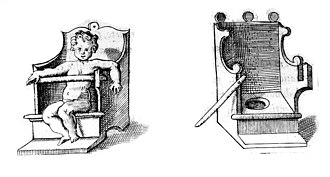
A 1577 illustration of a child seated on a specialized lavatory
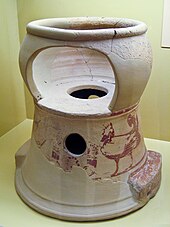
Little is known well-nigh toilet preparation in pre-modern societies. Ancient Rome has been credited with the earliest known children's toilet. Withal, there is no show of what training techniques they may have employed.[ane] : 4 Later, during the European Centre Ages, according to 1 source "Recommended cures for 'pyssying the bedde'...included consumption of footing hedgehog or powdered goat hook and having dried rooster combs sprinkled on the bed."[2]
Cultural behavior and practices related to toilet training in recent times have varied. For case, beginning in the belatedly 18th century parenting transitioned from the use of leaves or linens (or nothing) for the covering of a kid'south genitals, to the use of cloth diapers (or nappies), which needed to be washed by paw. This was followed by the advent of mechanical washing machines, so to the popularisation of disposable diapers in the mid 20th century, each of which decreased the brunt on parental time and resources needed to care for children who were not toilet trained, and inverse expectations well-nigh the timeliness of training.[1] : 3 [3] : 216 This trend did not manifest equally in all parts of the world. Those living in poorer countries normally train as early equally possible, as access to civilities such as dispensable diapers may still pose a significant burden.[4] Poorer families in adult countries likewise tend to train before than their more affluent peers.[5] : 43
Much of the 20th-century conceptualization of toilet preparation was dominated past psychoanalysis, with its emphasis on the unconscious, and warnings almost potential psychological impacts in later life of toilet training experiences. For instance, anthropologist Geoffrey Gorer attributed much of contemporary Japanese society in the 1940s to their method of toilet preparation, writing that "early on and severe toilet training is the well-nigh of import single influence in the formation of the developed Japanese character."[half dozen] [7] : 50–one [eight] : 201 [a] Some German kid-rearing theorists of the 1970s tied Nazism and the Holocaust to authoritarian, sadistic personalities produced by punitive toilet training.[10]
Into the 20th century this was largely abandoned in favor of behaviouralism, with an emphasis on the ways in which rewards and reinforcements increase the frequency of certain behaviors, and cerebral psychology, with an accent on meaning, cerebral ability, and personal values.[6] [7] Writers such as psychologist and pediatrician Arnold Gesell, along with pediatrician Benjamin Spock were influential in re-framing the issue of toilet training equally ane of biology and kid readiness.[2]
Approaches [edit]
Approaches to toilet preparation have fluctuated between "passive child readiness" ("nature"-based approaches), which emphasize private child readiness, and more than "structured behaviorally based" ("nurture"-based approaches), which emphasize the need for parents to initiate a grooming regime as soon as possible.[1] : iv [3] : 216 Amid the more pop methods are the Brazelton kid-oriented approach, the approach outlined in The Common Sense Book of Infant and Child Care by Benjamin Spock, the methods recommended past the American Academy of Pediatrics, and the "toilet training in a day" approach developed by Nathan Azrin and Richard One thousand. Foxx. Co-ordinate to the American Academy of Family unit Physicians, both the Brazelton and the Azrin/Foxx approaches are constructive for developmentally normal children, although the evidence has been limited, and no study has directly compared the effectiveness of the two.[11] Recommendations by the American Academy of Pediatrics follow closely with Brazelton, and at to the lowest degree one study has suggested that the Azrin/Foxx method was more than effective than that proposed by Spock.[eleven]
Opinions may vary greatly amidst parents regarding what the most effective approach to toilet training is, and success may require multiple or varied techniques according to what a child is most responsive to. These may include the use of educational material, like children'due south books, regularly querying a child about their demand to use the bath, demonstration by a parent, or some type of reward system. Some children may respond more positively to more brief but intense toilet training, while others may be more than successful adjusting more than slowly over a longer flow of fourth dimension.[12] : 12–three Regardless of the techniques used, the American Academy of Pediatrics recommends that the strategy use as much parental involvement and encouragement every bit possible, while avoiding negative judgement.[12] : 18–ix
The Canadian Paediatric Order makes a number of specific recommendations for toilet grooming techniques. These include:
- Using a toilet seat adapter, foot stool, or potty chair to ensure piece of cake access for the child
- Encouraging and praising the child when they inform caregivers of their need to evacuate, even when done subsequently the fact
- Being circumspect to a child'southward behavioural cues that may bespeak their demand to evacuate [13]
- Prefer encouragement and praise and avoid punishment or negative reinforcement
- Ensure all caregivers are consistent with their approach
- Consider transition to cotton fiber underwear or training pants in one case the child achieves repeated success[xiv]
Timeline [edit]
As psychologist Johnny L. Matson observes, using the toilet can be a complex process to master, from the power to recognize and control bodily functions, to the skills required to carry out proper hygiene practices, the requisite dexterity to dress and undress oneself, and the communication skills to inform others of the demand to use the toilet.[ane] : two–3 Usually around one year of age, a kid will begin to recognize the demand to evacuate, which might exist observed through changes in beliefs immediately prior to urination or defecation. Although they may recognize the need, children younger than 18 months may non yet be able to consciously control the muscles involved in elimination, and cannot however begin toilet preparation. While they may utilize the toilet if placed in that location by a parent at an opportune time, this likely remains an involuntary, rather than a conscious procedure.[12] : 25 This will gradually modify over the course of many months or years, with dark bowel control usually the commencement to manifest, followed by daytime control, and night bladder command normally terminal.[12] : 26
Toilet training practice may vary greatly across cultures. For example, researchers such as Mary Ainsworth have documented families in Chinese, Indian, and African cultures offset toilet training as early as a few weeks or months of age.[1] : 1–2 [3] : 216 In Vietnam, toilet training begins shortly after nativity, with toilet training consummate past age 2.[15] This may be mediated by a number of actors, including cultural values regarding excrement, the part of caregivers, and the expectation that mothers piece of work, and how soon they are expected to render to work post-obit childbirth.[16]
In 1932, the U.Due south. Government recommended that parents begin toilet training nearly immediately after birth, with the expectation that it would be consummate past the time the kid was six to eight months of age.[b] However, this shifted over time, with parents in the early 20th century kickoff grooming at 12–eighteen months of age, and shifting past the latter half of the century, to an average of greater than 18 months.[17] In the Us and Europe, preparation normally starts between 21 and 36 months, with merely 40 to 60% of children trained by 36 months.[11]
Both the American Academy of Pediatrics and the Canadian Paediatric Order recommend that parents begin toilet preparation around 18 months of age and then long equally the child is interested in doing so. There is some evidence to suggest that children who are trained after their second year, may be at a college chance for sure disorders, such as urological problem or daytime wetting.[eighteen] At that place is no prove of whatsoever psychological problems resulting from initiating grooming too early.[19] : 83 In a study of families in the Britain, researchers found that ii.i% began training prior to half dozen months, 13.8% between 6 and fifteen months, fifty.4% between xv and 24 months, and 33.7% had not begun training at 24 months.[xix] : 83
The majority of children volition reach consummate bladder and bowel control between ages two and four.[1] : 3 [xx] [21] : 162 While 4-yr-olds are usually reliably dry during their waking hours, as many as ane in five children aged five will occasionally moisture themselves during the night.[22] Girls tend to complete successful preparation at a somewhat younger historic period than their male peers, and the typical time catamenia between the beginning and completion of training tends to vary between three and 6 months.[xiv]
Accidents [edit]
Accidents, periodic episodes of urinary or fecal incontinence, are generally a normal office of toilet training [13] and are normally not a sign of serious medical issues. Accidents that occur with additional problems, such as pain when urinating or defecating, chronic constipation, or blood in urine or carrion, should be evaluated past a pediatrician.[23] The prevalence of nocturnal enuresis, besides known as bed wetting, may be as loftier as 9.7% of 7-year-olds, and five.five% of x-year-olds, eventually decreasing to a rate of about 0.five% in adults.[24] : 47
Complications [edit]

Toilet training can be increasingly difficult for parents of children who take sure developmental, behavioral or medical disorders. Children with autism, fetal booze spectrum disorder, oppositional defiant disorder, or attending deficit hyperactivity disorder may not exist motivated to complete toilet training, may have difficulty accordingly responding to associated social reinforcements, or may have sensory sensitivities which make using the toilet unpleasant.[21]
Children may have a range of physical problems related to the genitourinary system, that could require medical assessment and surgical or pharmacological intervention to ensure successful toilet training. Those with cerebral palsy may confront a unique set of challenges related to bladder and bowel control, and those with visual or auditory problems may crave adaptations in the parental approach to training to compensate, in addition to therapy or adaptive equipment.[20]
Stool toileting refusal occurs when a child that has been toilet trained to urinate, refuses to use the toilet to defecate for a period lasting at least one month. This may affect as many every bit 22% of children and tin can result in constipation or pain during elimination. Information technology usually resolves without the need for intervention.[11] Children may exhibit stool withholding, or attempts to avoid defecation all together. This can too result in constipation. Some children will hide their stool, which may be done out of embarrassment or fear, and is more than probable to be associated with both toileting refusal and withholding.[xi]
Although some complications may increase the time needed to achieve successful bladder and bowel control, most children tin be toilet trained even so.[ane] : iii [20] [21] : 162 Physiological causes of failure in toilet grooming are rare, as is the need for medical intervention. In almost cases, children who struggle with training are most likely not yet ready.[11] [xiv]
Risks [edit]
An examination of data from hospital emergency rooms in the United states of america from 2002 to 2010 indicated that the most common form of toilet training related injury was acquired by falling toilet seats, and occurred almost oftentimes in children aged two to iii. The second about common injury was from slipping on floors, and 99% of injuries of all types occurred in the home.[ane] : 176
In abusive homes, toilet training may be a trigger for child maltreatment, especially in circumstances where a parent or caregiver feels the child is erstwhile enough that they should have already successfully mastered grooming, and all the same the kid continues to have accidents.[25] : 311 [26] : 50 This may exist misinterpreted past the caregiver as willful disobedience on the part of the child.[27]
Technologies and equipment [edit]
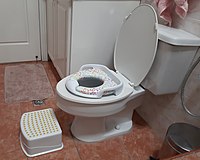

Toilet seat adapter and footstool (left), and plastic moulded potties (right)
As early as 1938, among the start technologies developed to address toilet training was known as the "bell and pad", where a sensor detected when a child had moisture themselves at dark, and triggered an alarm to human action as a form of conditioning. Similar alarm systems take been studied that sense wetness in undergarments, especially as information technology concerns the toilet training of those with intellectual disabilities. This has been practical more than recently in the product of potties, that play an audible cheer or other form of encouragement when used by a child.[i] : 170–2
Trainers may choose to employ different choices of undergarments to facilitate preparation. This includes switching from traditional diapers or nappies to training pants (pull-ups), or the use of not-absorbent cotton underwear of the type adults may wear. These are typically employed later in the training process, and not as initial step.[i] : 175 [28] Children who experience repeated accidents subsequently transitioning to cotton undergarments may be allowed to resume the employ of diapers.[xiv]
Nearly widely used techniques recommend the utilize of specialized children's potties, and some recommend that parents consider using snacks or drinks as rewards.[11]
Come across too [edit]
- Baby-led potty grooming, a method of toilet training
- Elimination communication, an arroyo to parent-babe advice
- Enuresis, the repeated inability to control urination
- Housebreaking, the procedure of training a domesticated animal
- Infant potty grooming method, method of training and volume by Laurie Boucke
- Open-crotch pants, clothing commonly worn by children in China that allows emptying without removal
Notes [edit]
- ^ A similar determination was reached by Anthropologist Ruth Benedict. All the same, following the determination of Earth State of war 2, major problems with their characterizations of the toilet preparation habits of Japanese families, and their conclusions had been reached largely without information from field studies.[ix] : 186
- ^ According to the original text of the publication, The Care and Feeding of Infants, "If you tin can, kickoff training your infant to take a bowel move in the sleeping accommodation each morning at the age of 1 month. … Place the chamber on your lap … and hold the babe over it. … Insert about ii inches into the rectum, a tapered soap stick, go along information technology there from iii to 5 minutes… The move will usually occur under this stimulus. If you keep this upward with regularity, a daily bowel movement volition probably result."[6]
References [edit]
- ^ a b c d east f g h i j Johnny 50. Matson (4 October 2017). Clinical Guide to Toilet Training Children. Springer Publishing. ISBN978-3-319-62725-0.
- ^ a b Nick Haslam (vii June 2012). Psychology in the Bathroom. Palgrave Macmillan UK. ISBN978-0-230-36755-5.
- ^ a b c Valsiner, Jaan; van Dijk, Jan (two February 2000). Culture and Human being Development. SAGE Publishing. ISBN978-0-7619-5684-6.
- ^ Howard, Jacqueline (8 November 2017). "How the world potty trains". CNN. Retrieved 15 July 2019.
- ^ Marcdante, Karen; Kliegman, Robert M. (25 February 2014). Nelson Essentials of Pediatrics. Elsevier Health Sciences. ISBN978-0-323-22698-i.
- ^ a b c Twenty-four hour period, Nicholas (xvi April 2013). "I'm Supposed to Do What to Make My Babe Poop? When He'south How Onetime?". Slate . Retrieved 15 July 2019.
- ^ a b Kathleen Stassen Berger (12 May 2014). Loose-leaf Version for Developing Person Through the Life Bridge: Paperbound. Worth Publishers. ISBN978-ane-319-02949-iv.
- ^ Rudolf Five. A. Janssens (1995). "What Future for Japan?": U.Due south. Wartime Planning for the Postwar Era, 1942-1945. Rodopi. ISBN90-5183-885-ix.
- ^ Eysenck, Hans Jürgen (1991). Reject and Fall of the Freudian Empire. Transaction Publishers. ISBN978-one-4128-2137-vii.
- ^ Herzog, Dagmar (22 Jan 2007). Sex after Fascism: Memory and Morality in Twentieth-Century Germany. Princeton Academy Press. ISBN978-1-4008-4332-ix.
- ^ a b c d east f g Choby, Beth A.; George, Shefaa (1 November 2018). "Toilet Training". American Family unit Dr.. 79 (8): 1059–1064. Retrieved 16 July 2019.
- ^ a b c d DiMaggio, Dina. "How to Start Potty Preparation". The New York Times . Retrieved xvi July 2019.
- ^ a b "The Complete Toilet Learning Guide | The SOEL Fashion". SOEL. 2018-04-23. Retrieved 2020-09-07 .
- ^ a b c d Clifford, T.; Gorodzinsky, FP (September 2000). "Toilet learning: Anticipatory guidance with a child-oriented approach". Paediatrics & Child Health. 5 (6): 333–44. doi:10.1093/pch/5.6.333. PMC2819951. PMID 20177551.
- ^ "Vietnamese mothers' experiences with potty training procedure for children from nativity to ii years of age". Periodical of Pediatric Urology.
- ^ Gottlieb, Alma (20 November 2017). "Let these globe-trotting lessons in potty training flush your parental worries away". PBS NewsHour . Retrieved 16 July 2019.
- ^ Rogers, June (22 October 2002). "Toilet grooming: lessons to be learnt from the by?". Nursing Times . Retrieved xv July 2019.
- ^ Kiddoo, D. A. (8 August 2011). "Toilet preparation children: when to starting time and how to train". Canadian Medical Association Journal. 184 (5): 511–2. doi:10.1503/cmaj.110830. PMC3307553. PMID 21825046.
- ^ a b Stockman, James A. III (i January 2011). Yr Volume of Pediatrics 2011. Elsevier Health Sciences. ISBN978-0-323-08746-9.
- ^ a b c Cocchiola, Michael A. Jr.; Redpath, Caroline C. (2017). "Special Populations: Toilet Grooming Children with Disabilities". Clinical Guide to Toilet Preparation Children. Autism and Child Psychopathology Series. Springer Publishing. pp. 227–250. doi:10.1007/978-3-319-62725-0_13. ISBN978-three-319-62724-iii . Retrieved 12 July 2019.
- ^ a b c Wolraich, Mark; American Academy of Pediatrics (2016). American University of Pediatrics Guide to Toilet Training. Runted Books. ISBN978-0-425-28580-0.
- ^ "How to potty railroad train – Your pregnancy and baby guide". National Wellness Service . Retrieved 15 July 2019.
- ^ "Potty Training Problems". What To Expect . Retrieved July 15, 2019.
- ^ Franco, Israel; Austin, Paul; Bauer, Stuart (23 September 2015). Pediatric Incontinence: Evaluation and Clinical Direction. Wiley. ISBN978-1-118-81475-8.
- ^ Cozza, Stephen J. (30 March 2014). Disaster and Trauma, An Issue of Child and Adolescent Psychiatric Clinics of N America, E-Volume. Elsevier Health Sciences. ISBN978-0-323-28992-4.
- ^ Clark, Robin Due east.; Freeman Clark, Judith; Adamec, Christine A. (2007). The Encyclopedia of Child Corruption. Infobase Publishing. ISBN978-0-8160-7506-5.
- ^ "Toilet Training". American University of Pediatrics . Retrieved 16 July 2019.
- ^ Gorski, Peter A.. (half-dozen June 1999). "Toilet Training Guidelines: Parents—The Role of the Parents in Toilet Preparation" (PDF). Pediatrics. 103 (half dozen Pt ii): 1362–1363. PMID 10353955. Retrieved xvi July 2019.
Further reading [edit]
- Schum, T. R.; Kolb, T. M.; McAuliffe, T. L.; Simms, K. D.; Underhill, R. L.; Lewis, One thousand. (2002). "Sequential acquisition of toilet training skills: A descriptive study of gender and age differences in normal children". Pediatrics. 109 (three): e48. doi:x.1542/peds.109.3.e48. PMID 11875176.
- Blum NJ, Taubman B, Nemeth N (2003). "Relationship betwixt age at initiation of toilet preparation and duration of training: A prospective study". Pediatrics. 111 (4 Pt i): 810–four. doi:10.1542/peds.111.4.810. PMID 12671117.
- Devries, MW; Devries, MR (1977). "Cultural relativity of toilet training readiness: A perspective from East Africa". Pediatrics. 60 (2): 170–vii. PMID 887331.
External links [edit]
- "Toilet Training". Johns Hopkins School of Medicine . Retrieved 16 July 2019.
Can a Baby Potty Train at 11 Months Old
Source: https://en.wikipedia.org/wiki/Toilet_training
0 Response to "Can a Baby Potty Train at 11 Months Old"
Post a Comment