Fundamentals of Drawing and Painting
Thefundamentals of fine art are what I consider to be the edifice blocks of an artwork. They are color, limerick, value, class, brushwork, and perspective.
The fundamentals are generally universal across different mediums and styles. Learning them will help you become a well-rounded and versatile creative person.
Color
I like to break color into 2 parts: color theory and color mixing and application. Successful use of color in painting requires a thorough understanding of both.
Color theory refers to the trunk of principles which address how nosotros see colour and what it is.
The theory is much easier to embrace by breaking color into its iii individual elements, being hue, saturation, and value.
Hue: Where the color is located on the color wheel. Cherry-red, blue, xanthous, dark-green: these are different hues.
Saturation: How vivid or rich a color is. A color which is highly saturated is brilliant. A low saturation color is weak and close to gray.
Value: How light or night a color is, on a scale of white to black. Loftier-value colors are low-cal and low-value colors are dark.
Color mixing and application is all well-nigh taking what nosotros know about color and effectively translating that into our paintings.
Well-nigh of this comes down to feel and time spent on the canvass. Color mixing exercises and creating small colour studies (like the ones below) are also incredibly valuable for grooming your utilize of colour.

Dan Scott, Color Studies, 2018
You can learn more in my Color Guide.
Composition
Limerick broadly refers to how well all the visual elements work together in an artwork. The visual elements are the edifice blocks of artwork and incorporate of line, shape, color, value, space, form, and texture.
A well-designed limerick volition exist inviting and convey the large idea of the artist. Everything will only wait like it fits.
Limerick is often discussed in clan with the principles of fine art, which are a ready of criteria which are used to explain how the visual elements are bundled in a work of fine art. They contain of pattern, residue, emphasis, dissimilarity, harmony, variety, movement, proportion, and calibration.
Some other concepts which tin assist with your compositions are:
Rule of Thirds: A technique which involves segmenting the composition by thirds both horizontally and vertically. The intersections are considered to exist aesthetically pleasing areas to position focal points. The rule of thirds can also be used to ensure your composition is not overly symmetrical.
In the beautifulOphelia past John Everett Millais, notice how key features of the painting are positioned around the intersecting lines, in item, the female subject'southward confront.

John Everett Millais, Ophelia, 1851–1852
Simplification: Much of art and composition is about taking what we see and simplifying information technology into something articulate and concise on the sail. It is almost simplifying the "noise".
In John Singer Sargent'sVenice in the Fog, notice how much of the item has been simplified. The people and boats are depicted with nothing but a few night color shapes; the buildings in the background are faint and basic; the water and sky are simply thin washes of color.

John Singer Sargent, Venice in the Fog, 1882
Rule of Odds: The thought that objects in odd numbers can appear more naturalistic than objects in even numbers. This influenced my decision to have three boats in the painting below, rather than just 2.
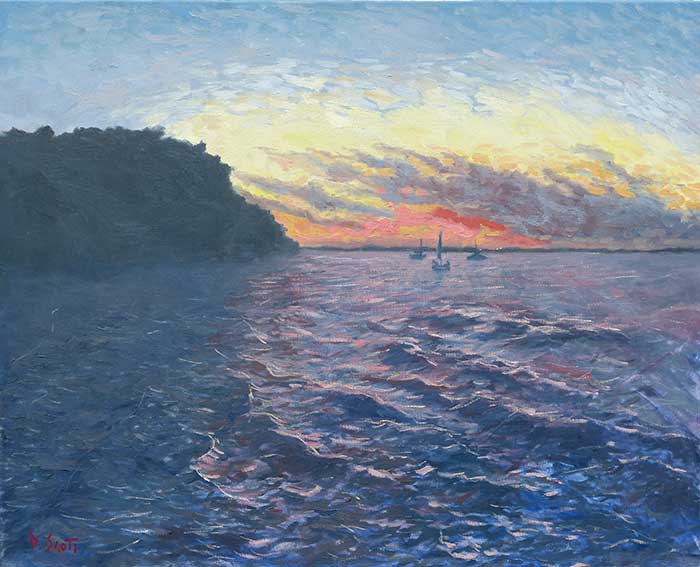
Dan Scott, Three Boats at Kingfisher Bay, 2016
Yous can learn more than in my Limerick Guide.
Value
Value refers to how light or nighttime a color is. It is one of 3 elements of a colour (the other two being hue and saturation), only information technology is usually considered as a separate primal expanse due to its importance to the structure and appeal of an artwork.
Painting with authentic values can become a long way in giving your art a quality of realism, even if your brushwork is loose. Take Sir Arthur Streeton's painting beneath for example. If you look closely, you will notice that Streeton did not carefully render every detail. His brushwork was loose and fluent. Simply, despite this, there is a wonderful sense of realism about the painting. You really go a feel for the dry Australian landscape. That is because Streeton had a remarkable eye for value.

Arthur Streeton, Golden Summertime, Eaglemont, 1889
You can see all the dissimilar values in the grayscale image below. Annotation that the value relationships are more than important than the individual values. That is, how light or nighttime one area is compared to the surrounding areas. Streeton painted in a high cardinal (painted with mostly light colors), just all the value relationships are very accurate, giving his work a stiff quality of realism.

You lot can learn more in my Value Guide.
Grade and Structure
Class and structure refer to the use of visual elements to convey 3-dimensional objects on a flat surface. This could be done through methods such equally shading, contrast or contour cartoon.
Most subjects can exist simplified down to basic forms of spheres, boxes, and cylinders. Take the seascape painting below by Frederick Judd Waugh.
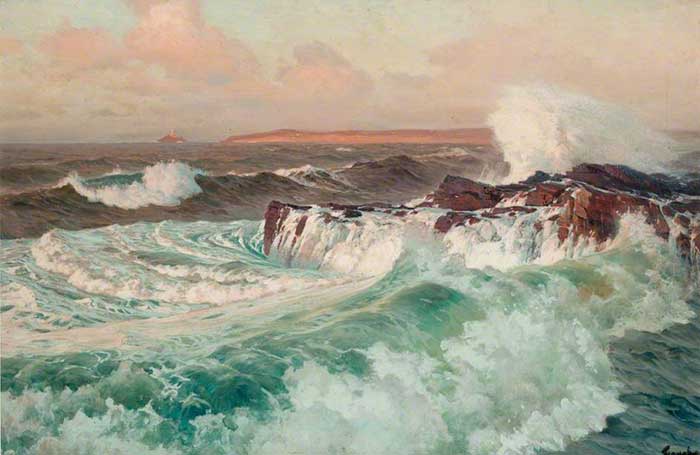
Frederick Judd Waugh, Seascape
The waves and rocks are actually just an arrangement of spheres, boxes, and cylinders.

Agreement the basic forms and structures which brand up your subject will allow yous to paint more convincing depictions. That is why many portrait artists dedicate and then much time to studying man anatomy.
Brushwork

Claude Monet, Arch to the West from Etretat, 1883
How you apply your castor and dispense pigment on the canvas can be a key feature of your artwork. Much like the assuming strokes in Vincent van Gogh'south work, or the fleeting dabs of color in Claude Monet'due south piece of work.
A general guideline I similar to follow with my brushwork is to match the nature of my brushwork to the nature of the subject I am painting. For example, to paint rough, turbulent h2o, I would utilise rough, turbulent brushwork. For calm h2o, I would utilise calm, smoothen brushwork.
I also like to use my brush to follow the contours of the subject area. This helps reiterate the form. Van Gogh did this in many of his paintings, like his A Pair Of Leather Clogs below:
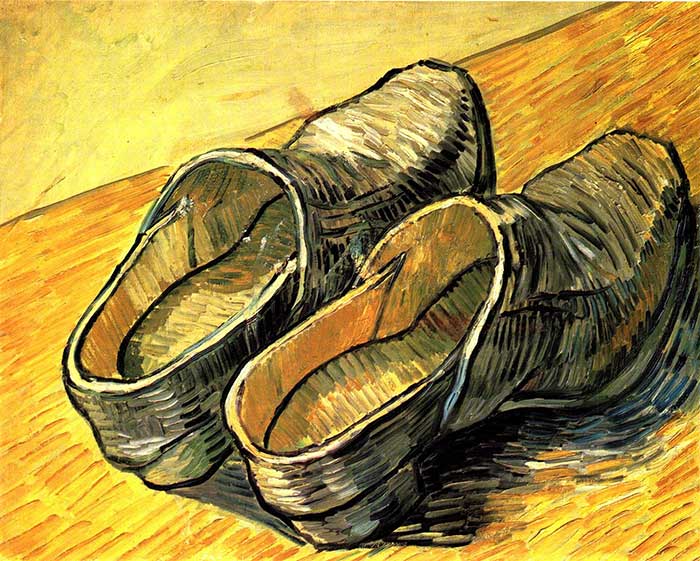
Vincent van Gogh, A Pair Of Leather Clogs, 1888
You can acquire more in my Brushwork Guide.
Perspective
Perspective in art refers to the delineation of a three-dimensional environment on a ii-dimensional surface in a style that captures the relative size, position, and appearance of objects. It is made up of two parts: linear perspective and aerial (or atmospheric) perspective.
Linear Perspective
Linear perspective is used by artists to determine the relative size, position, and shape of objects by using fatigued or imagined lines which converge at a point on the horizon (vanishing point). When one vanishing point is used, that is called i-signal perspective. When two vanishing points are used, that is called two-betoken perspective, and so on.
Below are two examples of one-point perspective in action:

Vincent van Gogh, Vincent's Bedroom In Arles, 1889 - I Point Perspective
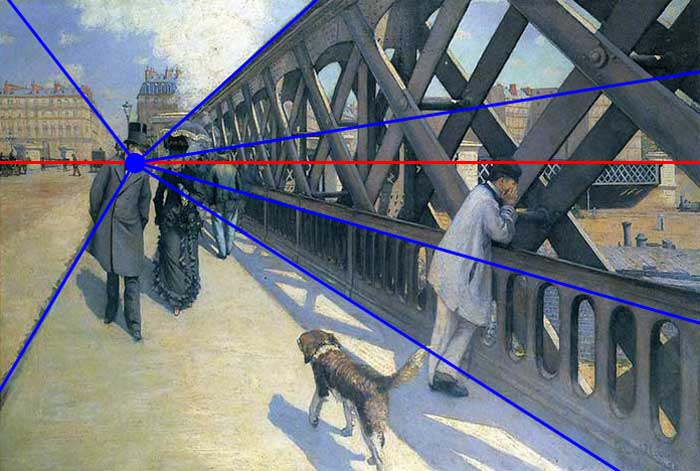
Linear perspective is more than important when painting rigid compages than information technology is for landscape painting. That is because mistakes in perspective tend to be more apparent when painting things similar buildings, houses, roads, paths, etc.
Aerial (or Atmospheric) Perspective
Aeriform perspective is the effect of the atmosphere on the view of objects as they recede into the distance. Equally an object recedes into the distance relative to the viewer, the contrast, value (darkness), colour saturation and detail all fade.
When beginner painters ask me to critique one of their paintings, one of the common problems is the distant elements of the painting (i.eastward. the afar mountains in a landscape) are painted with the same level of particular and color as the remainder of the painting. This gives an unnatural aerial perspective.
In many cases, the nigh "realistic" mount yous could pigment in the far distance may be nothing more a unproblematic, faint blue colour shape. Check out the mountains in the distance of this painting by Monet:

Claude Monet, Juan-Les-Pins, 1888
Desire to Acquire More?
You might be interested in my Painting Academy course. It covers the fundamentals of painting in depth. More details here if interested.
Thanks for Reading!
Thanks for taking the time to read this mail service. I appreciate information technology! Experience free to share with friends. If you lot want more painting tips, check out my Painting Academy grade.
Happy painting!
Dan Scott
Describe Pigment Academy
Source: https://drawpaintacademy.com/fundamentals-of-art/
0 Response to "Fundamentals of Drawing and Painting"
Post a Comment