How to Upload Pictures From Google Dummies
How to Use Google Photos
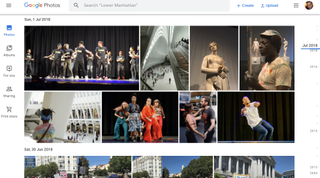
Y'all probably have thousands of photos scattered between your smartphone, your tablet, your camera, and your laptop, with no piece of cake manner of knowing which pictures are where. Google Photos is an easy and free way to organize and sync all of your images, then yous can access them no matter where you are and which device you're using. That'south why Google Photos is one of the best photo storage and sharing sites around.
The service uses Google's paradigm-analysis technology to organize photos and videos, making them easier to search and share. Google Photos provides unlimited storage for free, and offers paid options for people who desire to store higher-quality versions of their media.
Hither's how to get up and running with Google Photos in a few easy steps.
- The best cloud storage for photos and pictures: free and paid
- Amazon photo storage vs Google Photos: Which is best?
Step 1: Install the Photos app on your devices
Google Photos provides costless apps for smartphones in the Apple App Store (opens in new tab) and Google Play store; at that place's also a web-based version of Google Photos for uploading pictures and videos from PCs and Macs. But instead of downloading full copies of your photos from other devices, the apps simply provide online previews of what you've stored in Google'south cloud. As a consequence, your smartphone'due south storage won't be swamped if you take uploaded thousands of photos and videos from your home PC.
(Google Photos and Google Bulldoze used to automatically sync their photograph collections, merely that feature was disabled in 2019. Google provides instructions on how to manually select photos in Drive and copy them over to Photos.)
The first thing I noticed after downloading the Google Photos app was how many garbage images I had on my iPhone, including failed shots similar a close-up of my finger and reminder snaps I'd take of a sign. Using Google Photos gave me an opportunity to weed out the junk, which I could do either in the mobile app or in the spider web interface on my computer. In the app, a trashcan icon appears below the image (forth with icons for editing, sharing, and searching for similar images). In the spider web version, click on a photo to bring it upwardly in a new window, and click on the trash can icon displayed on the upper correct.
MORE: Best photo editing software
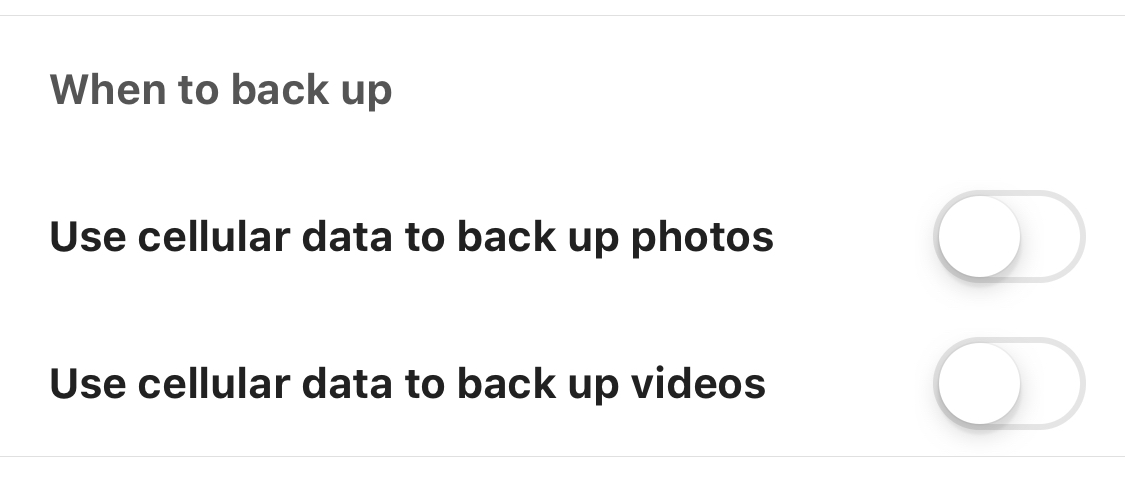
To preclude photo and video uploads from blowing through your data cap, the mobile app can be set to upload but over Wi-Fi. To confirm that setting (or alter it), press the menu icon (iii parallel lines) on the upper left of the app. So click Settings>Support & sync. Make sure the 2 switches at the bottom of the screen, "Use cellular data to back up photos" and "se cellular data to dorsum up videos," are turned off.
Stride 2: Select the quality level for uploads
Google Photos is currently complimentary — if y'all concur to let it store compressed copies of your media. If the pictures are larger than 16 megapixels, Google Photos will downsize them to that size. (The originals on your computer or mobile device are not altered.) Videos are capped at 1080p resolution. You can salve unaltered originals, including RAW image files, using the Original setting in the app, and store them in your Google Drive account, which includes 15GB of gratis storage. (That storage is shared amongst all Google services, such as your Gmail or Google Docs business relationship.) If you demand more space for your unaltered originals, you lot tin upgrade, from 100GB for $i.99 per calendar month, to 2TB for $9.99 per month.
Notation as well that complimentary storage comes to an finish on June 1.
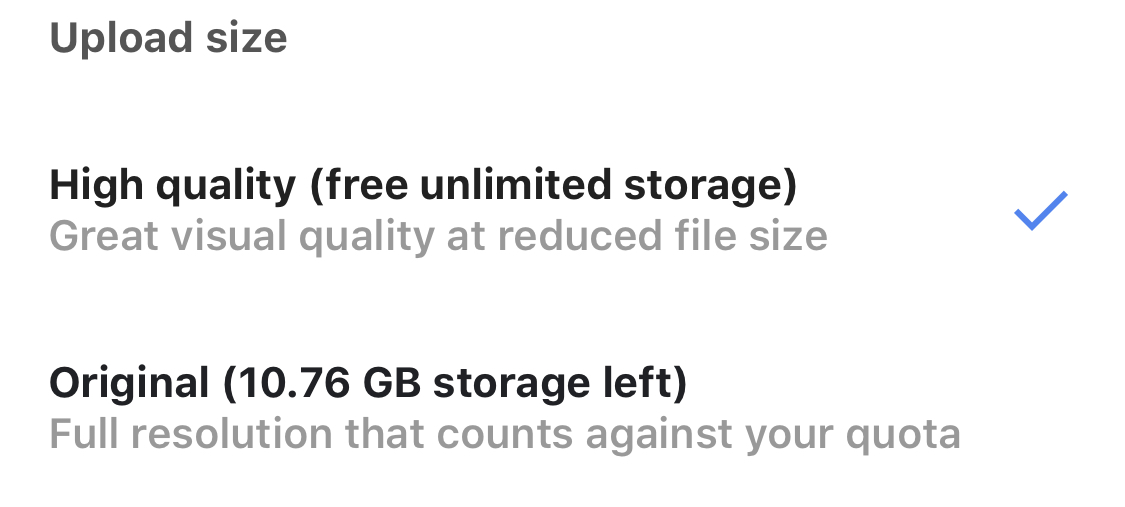
Unless you're extremely fussy, the costless choice is fine. I uploaded copies of the same photograph of my boss Marking, shot with a pro-grade Canon 5D Marking Two DSLR, using both the High Quality (i.eastward. compressed) and Original settings. No one in our role — including the photographer who took the photo — saw a clear difference onscreen.



That'due south especially impressive because the unaltered JPEG version was 4.5MB, whereas the other JPEG was just 0.85MB. You can see for yourself by clicking on the two images below to view cropped portions displayed at 100 percent.
With many new cameras shooting twenty-MP and larger images, y'all may lose some resolution with the complimentary option, but even a sixteen-MP epitome is larger than you can display at full size online and big plenty for at least a 12 x 14-inch print.
Step 3: Navigate your images
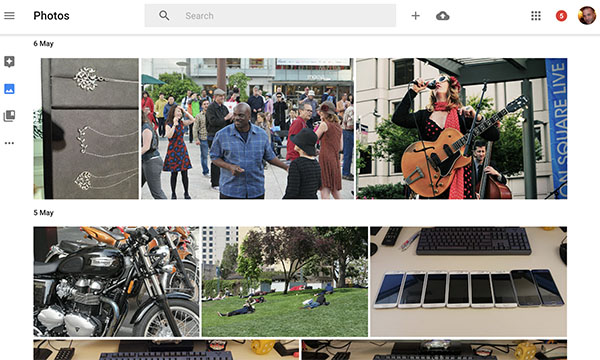
By default, Google Photos opens in the Photos view, which organizes images and videos by appointment, with the newest ones at the top. On the mobile app, you tin can spread your fingers over the screen to zoom in and view the photos past month, then day and then private photos. Then, yous can pinch to zoom back out. In the web interface, y'all can click on a timeline that runs down the right side of the page.
Tapping the Albums icon at the bottom of the mobile app or the left of the spider web interface brings upwardly a new view, organized by People, Places, Things, Videos, Collages, Animations, and Movies, which are edited videos. (We'll discuss actual album creation subsequently on.) The first category uses face up-recognition engineering science to grouping photos of the same person. This is a mutual characteristic in most photo-organizing apps, as is organizing photos by place, if they were taken on a smartphone or GPS-enabled camera that records location data.
Clicking on the People category brings up portrait photos, and clicking each portrait brings up all the pictures that Google thinks are of the aforementioned person. If a photo doesn't belong, click on it to bring up a new screen in the app (or click the "i" icon on the web), coil down to "People" and click the pencil icon to the right. Then click the red dot on the thumbnail of the album y'all want to remove information technology from,` or click the blue dot on the album you want to add it to.
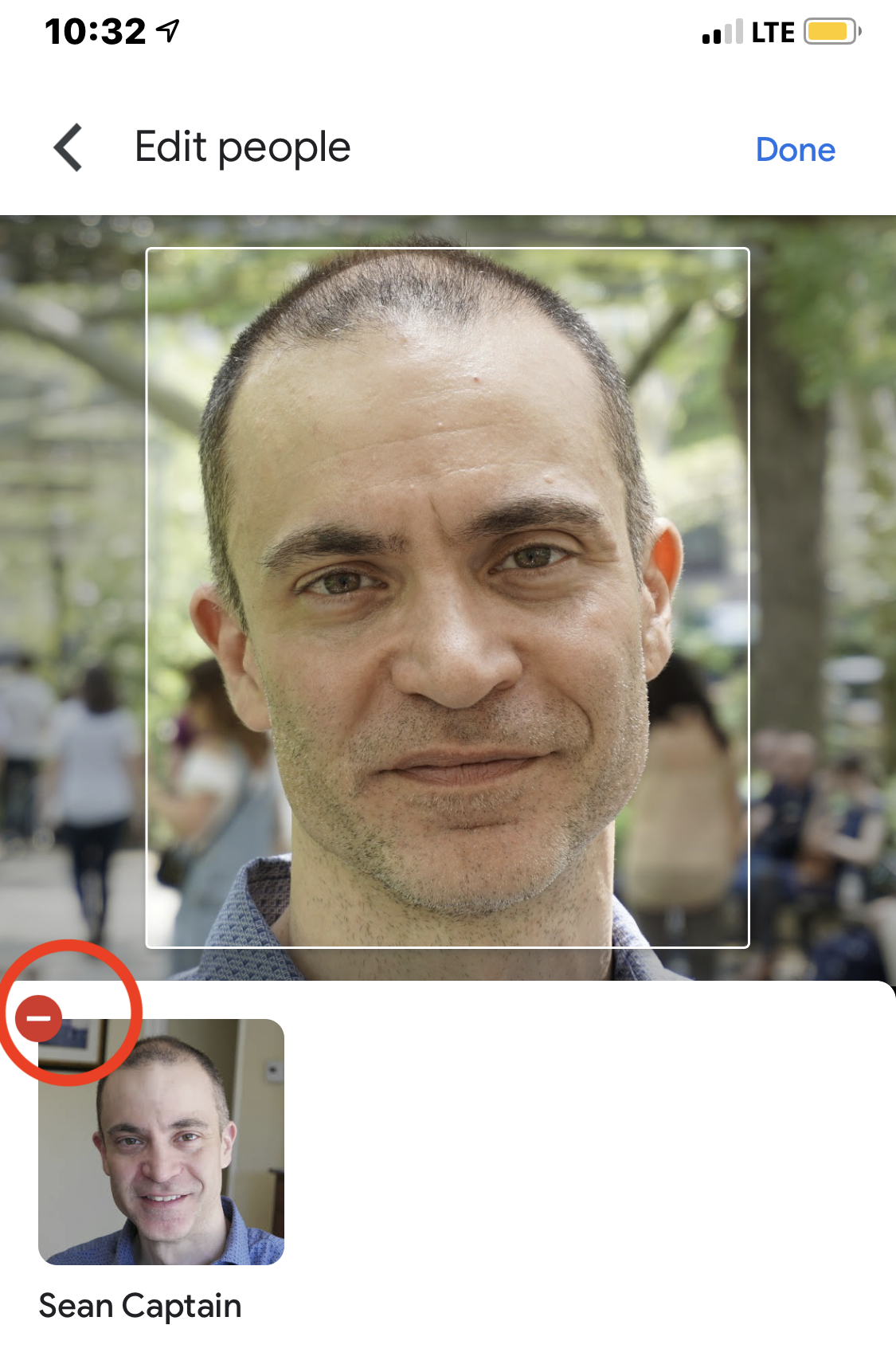
Yous tin proper noun the person in the photos by tapping "Add a proper name" nether their principal contour picture. If you do that for your own photo, Google assembly your account with the pictures. Your contacts in Google Photos or in your Gmail address book will exist alerted if you lot appear in a photo they accept, and Photos will suggest that they share the picture with you. If yous find this degree of personalization creepy, don't characterization your grouping of faces. If yous already have and want to undo it, tap the 3 dots in the upper right of the screen, and select "Remove name label." You lot can shut off face recognition completely past going to Settings (from the main screen), selecting Grouping similar faces, and clicking off the switch side by side to "Face group."
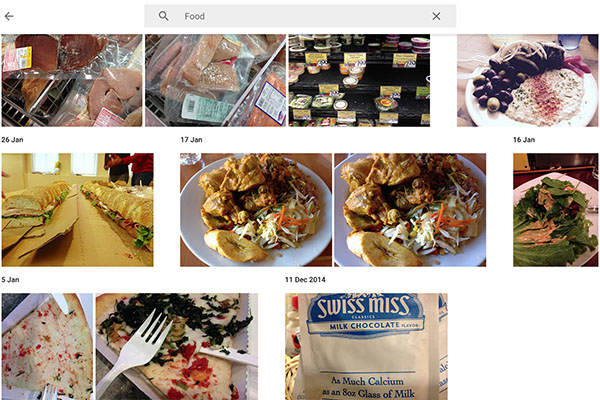
In Things, Google uses its image-search applied science to identify the discipline of the photo. My initial batch of examination photos yielded Things in both broad categories, such as Nutrient, Sky, Selfies and Cars, and more specific ones, such equally Stained glass and Fog (both of which I did photograph). Food worked perfectly — showing snaps of sushi, pizza, a supermarket cart and even an advertizing for hummus and a packet of hot chocolate mix. The Cars category was pretty funny but less accurate, featuring a car and a truck, but also a video of someone on a subway train and a portrait of someone with cars in the background.
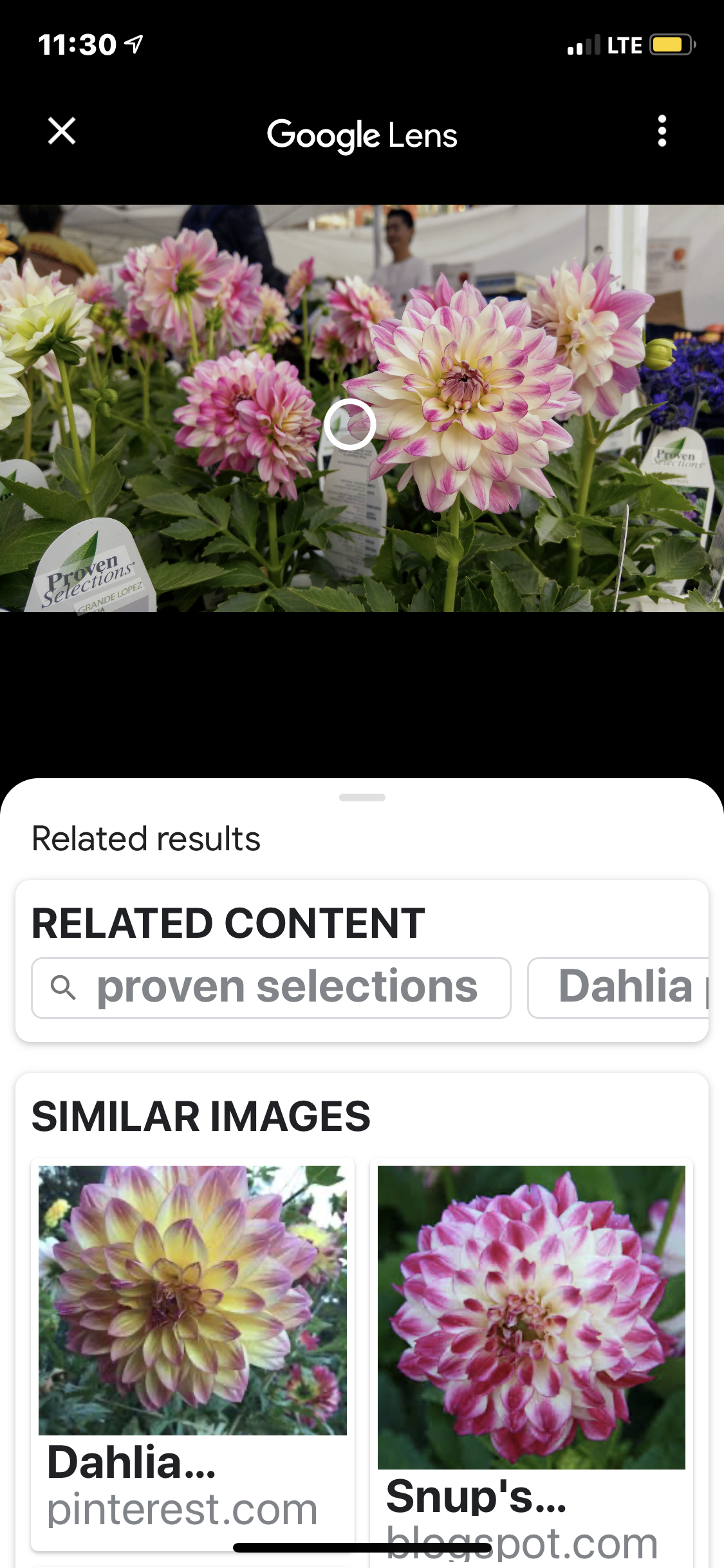
When yous bring up an individual photo, you tin can also click below it on icon of a dot inside a square to actuate Google lens. It will analyze the photo and provide search results of similar images from effectually the web. For instance, I learned that some flowers I shot in the park are examples of the dahlia pinnata variety.
Step 4: Edit your pictures
Google Photos offers a good array of editing tools in the app and web interface. You lot might start with crop and rotate to trim the photo and tilt it if the shot was kleptomaniacal. For quick touchups, the app offers 12 Instagram-way filters with ambiguous names. West, for instance, cranks upward the whites in images, and Vista is a high-contrast black-and-white event. Each filter has a slider that lets you adapt the intensity of the effect. Y'all tin save a copy with your effects, and you always have the Cancel option to undo all changes.
There are also traditional adjustments, beginning with Light (effulgence) and Color (spelled "Color" in the web version) . Tapping an pointer to the right of the Lite and Color sliders displays fine-grained adjustments, such as Exposure, Contrast and Highlights under Lite; and Saturation and Warmth under Color. The Colour section also features specialty adjustments called Pare tones and Deep blue (for skies and water).
Editing video clips (possible only in the app) is limited to trimming from the start or end of a clip or rotating the video if the orientation came out wrong (such as upside down) when yous shot it. (Later on, we'll show how yous can combine multiple clips into a movie.)
Step 5: Create albums, photo books, collages and movies
Google Photos lets you combine your images into an Anthology, Collage or Animation (a serial of photos that play in a looping slideshow you can share every bit an animated GIF).Yous create them notwithstanding way: by reviewing your photos and selecting the ones you want to include. Yous can and then add, delete or rearrange images to your liking.
You lot can also arrange images to make photo books, which you receive in print form. (Books get-go at $ix.99 and go upwardly based on the number of photos. Y'all can too order individual prints and prints on sheet).
Movie cosmos is available only in the mobile app, since it relies on the bear upon screen for making quick edits. Outset select multiple clips or photos (up to 50). You tin can elevate and drop clips to prepare the society they play in and slide your finger across each prune to select its starting time and endpoint. You can besides replace the recorded audio with another sound file.
Sharing is a big part of Google Photos. By default, all of your photos and videos (and anything you create using them) are individual. You can share a unmarried photo or video by tapping on it and selecting the upload icon on the lower left of the screen. On iOS devices, the icon is a box with an arrow coming out of it, and on an Android devices, information technology'due south a "<" icon. (Sharing Albums, Animations, Collages and other creations works similarly.)
The Share push brings upwardly the standard options for your iOS or Android phone, such as email, Facebook, Twitter or text message. These options depend, in role, on which apps yous have installed on your phone. (If y'all have a Gmail account, you as well see thumbnails of suggested contacts to electronic mail direct.) Yous tin can besides click the Create link button to generate a unique URL for your selections that you can paste into an electronic mail, text or other bulletin. That URL isn't tied to the person you send it to; anyone with the URL can view the photos associated with it. Yous can, however, revoke a URL to cut off views at any time.
More: How to Have a Great Selfie
You lot can also select multiple pictures by pressing down on one of them for a few seconds until a circle appears in the upper left of each image; then tap photos ane by one to select them. Alternately, just elevate your finger across a whole agglomeration to photos (without showtime pressing downwards) to get them all at once
Bottom line: A good starting point
Google Photos is very efficient for uploading, storing and syncing your photos and videos. Its automated tools, such the Things album or Lens, provide handy ways to search your own photos, recognize text and detect related textile on the web.
If y'all are a professional or even a serious amateur photographer, the heavy pinch of images (despite how good they look) in the free version volition probable exist a deal-breaker. The price for storage of full resolution photos is in line with what you would get from other cloud services, similar Dropbox Even if Google Photos isn't your main storage site, there's no harm in using a free account equally a second repository to easily share samples of your images.
You aren't giving up whatsoever rights to your creations, and Google (at to the lowest degree for at present) has no plans to "monetize" the content.
And if your main desire is to quickly share snapshots from your trove of cellphone pics, Google Photos is a very handy tool indeed.
- All-time photo editing apps
- The best cloud storage for photos and pictures: free and paid
Follow Sean Captain @seancaptain. Follow us @TomsGuide and on Facebook.
Source: https://www.tomsguide.com/us/google-photos-tutorial,review-2858.html
0 Response to "How to Upload Pictures From Google Dummies"
Post a Comment