Ill Never Have That Recipe Again
| "MacArthur Park" | ||||
|---|---|---|---|---|
 Artwork for The states unmarried release, as well used for German release | ||||
| Single past Richard Harris | ||||
| from the album A Tramp Shining | ||||
| B-side | "Didn't We?" | |||
| Released | April 1968 | |||
| Recorded | Dec 21, 1967 | |||
| Studio | Audio Recorders, Hollywood | |||
| Genre | Orchestral popular | |||
| Length | 7:21 | |||
| Label | Dunhill | |||
| Songwriter(s) | Jimmy Webb | |||
| Producer(due south) | Jimmy Webb | |||
| Richard Harris singles chronology | ||||
| ||||
"MacArthur Park" is a song written by American vocalizer-songwriter Jimmy Webb that was recorded first past Irish histrion and singer Richard Harris in 1968. Harris'southward version peaked at number two on the Billboard Hot 100 chart and number 4 on the UK Singles Chart. "MacArthur Park" was later covered by numerous artists, including a 1969 Grammy-winning version by state music singer Waylon Jennings and a number 1 Billboard Hot 100 disco organization past Donna Summer in 1978.[1]
In 1967, producer Bones Howe had asked Webb to create a pop vocal with different movements and irresolute time signatures. Webb delivered "MacArthur Park" to Howe with "everything he wanted", simply Howe did not care for the aggressive arrangement and unorthodox lyrics and the song was rejected by the grouping the Association, for whom it had been intended.[2]
Jimmy Webb songwriting [edit]
Composition [edit]
"MacArthur Park" was written and composed by Jimmy Webb in the summer and fall of 1967 equally part of an intended cantata. Webb brought the entire cantata to the Association, but the group rejected information technology.[three] The inspiration for the song was his human relationship and breakup with Susie Horton.[4] MacArthur Park, in Los Angeles, was where the couple would occasionally meet for lunch and spent their about enjoyable times together.[5] At that time (the middle of 1965), Horton worked for Aetna insurance, whose offices were across the street from the park.[1] When asked by interviewer Terry Gross what was going through his mind when he wrote the song's lyrics, Webb replied that it was meant to be symbolic and referred to the end of a love matter.[6] In an interview with Newsday in Oct 2014, Webb explained:
Everything in the song was visible. There's nothing in it that's fabricated. The sometime men playing checkers by the trees, the cake that was left out in the pelting, all of the things that are talked about in the vocal are things I really saw. So it'southward a kind of musical collage of this whole love affair that kind of went down in MacArthur Park.... Back then, I was kind of like an emotional motorcar, like whatever was going on inside me would chimera out of the piano and onto paper.[4]
Webb and Horton remained friends, even after her marriage to another man. The breakup was also the primary influence for "By the Time I Become to Phoenix", another vocal written and composed past Webb.[1]
The thought to write and compose a classically structured vocal with several movements that could be played on the radio came from a challenge by music producer Basic Howe, who produced recordings for the Association.[iv] The song begins as a verse form about love, then moves into a lover's lament. The vocal consists of four sections or movements:
- A mid-tempo introduction and opening section, called "In the Park" in the original session notes,[7] is built around piano and harpsichord, with horns and orchestra added. This arrangement accompanies the song's main verses and choruses.
- A slow tempo and tranquillity section follows, called "After the Loves of My Life",[7] likewise recorded by Ed Ames on his 1968 LP, Apologize.
- An up-tempo instrumental section, chosen "Allegro",[seven] is led past drums and percussion, punctuated by horn riffs, and builds to an orchestral climax.
- A mid-tempo reprise of the start section, concludes with the last choruses and climax.
Richard Harris original version [edit]
Groundwork and release [edit]
"MacArthur Park" was first recorded by Richard Harris, after he met the composer at a fundraiser in East Los Angeles, California in late 1967. Webb had been invited to provide the musical properties at the piano. Out of the blue, Harris, who had simply starred in the film Camelot and had performed several musical numbers in it, suggested to Webb that he wanted to release a record. At showtime, Webb did not take Harris seriously, just subsequently he received a telegram from Harris requesting that Webb "come up to London and make a record".[one] Webb flew to London and played Harris a number of songs for the project, but none seemed to fit Harris for his pop music debut. The last song that Webb played for Harris was "MacArthur Park".[1]
The rails was recorded on Dec 21, 1967, at Armin Steiner'south Audio Recorders in Hollywood. Cord, woodwind, and brass overdubs were recorded over ii sessions on December 29 and 30.[7] The musicians in the original studio recording included members of the Wrecking Coiffure of Los Angeles-based studio musicians who played on many of the hit records of the 1960s and 1970s. Personnel used included Hal Blaine on drums, Larry Knechtel on keyboards, Joe Osborn on bass guitar, and Tommy Tedesco and Mike Deasy on guitars,[7] along with Webb himself on harpsichord.
The song was included on Harris's album A Tramp Shining in 1968 and selected for release every bit a single, an unusual pick, given the song'due south length and complex structure. It was released in April 1968[viii] and was played by 77 WABC on Tuesday April ix, 1968.[9] It made its fashion onto the Hot 100 at number 79 on May xi, 1968, peaking at number ii on June 22, 1968 behind Herb Alpert'southward "This Guy's in Love with You". It peaked at number 10 on Billboard'south Easy Listening survey and was number eight on WABC's overall 1968 nautical chart.[10] Information technology topped the music charts in Europe and Australia and as well won the 1969 Grammy Honour for Best System Accompanying Vocalist(s).[eleven]
Chart history [edit]
Donna Summer version [edit]
| "MacArthur Park" | ||||
|---|---|---|---|---|
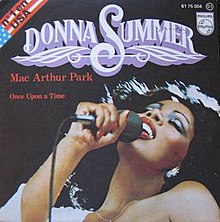 Artwork for the Spain single release, also used for the German release under different printing | ||||
| Single by Donna Summertime | ||||
| from the album Live and More | ||||
| B-side |
| |||
| Released | September 24, 1978 | |||
| Recorded | 1978 | |||
| Genre | Disco | |||
| Length | 8:27 (album version) iii:59 (single version) 10:47 (with reprise) | |||
| Characterization | Casablanca | |||
| Songwriter(s) | Jimmy Webb | |||
| Producer(s) |
| |||
| Donna Summertime singles chronology | ||||
| ||||
Background and release [edit]
In September 1978, American singer Donna Summer released a multi-million selling vinyl single disco version of "MacArthur Park". The vocal reached number 1 on the Billboard Hot 100 the week of November 11, 1978, for 3 weeks, and earned Summer her start nomination for the Grammy Award for All-time Female Pop Vocal Operation. Summer was also nominated for Favorite Pop/Rock Female at the American Music Awards where her album Live and More took the honour for Favorite Disco Album. She became the starting time female artist of the mod era to accept the number one single and album simultaneously on the Billboard pop charts (the calendar week of November 11, 1978).
Italian producer Giorgio Moroder would recall that he and his collaborator Pete Bellotte had been interested in the concept of either remixing a track – as yet undecided on – which had been a hit in the 1960s or else remaking a 1960s hitting as a dance rails: Moroder – "I remember that I was driving in... on the Hollywood Freeway, and I heard the original song [i.e. "MacArthur Park" past Richard Harris] on the radio. I idea: 'That's information technology – that's the song nosotros've been looking for well-nigh a year.'" Moroder asked Neil Bogart, president of Casablanca Records, to provide him with a copy of the Richard Harris version of "MacArthur Park" to serve equally ground for Moroder'due south envisioned discofied reinvention: Bogart obliged with an 8-track record containing Harris'southward version, prompting Moroder to buy an 8-track actor in order to hear it.[xx]
Moroder readily identified "MacArthur Park" as (quote) "a slap-up vocal for Donna – with all those high notes, it was perfect [for her]... First, I [located] a key that she could sing really high, just however with a big vocalism – that took an 60 minutes or two. I played a little piano and she sang it with my accompaniment. We constitute a fundamental and we had Greg Mathieson do the arrangement – and and then I did something very special" – that "something very special" being Moroder's recording of his ain vox to form a choir heard behind Summer on the song's chorus: "I recorded about 20 seconds of all the notes, which I was able to sing on a 24-track. I made a loop of those notes, and put that loop in the [Solid State Logic] desk. I could form eight chords past having C-E-G right on the group. I played the chords by moving the rail according to the chord that I needed." Of basing a discofied arrangement on the template for Webb'due south system on the Harris version Moroder would think: "To exist honest, information technology was a very hard vocal to [adjust], peculiarly the brass, but we had the best musicians in boondocks."[20]
Summertime'due south recording of "MacArthur Park", included every bit part of the "MacArthur Park Suite" on her double album Alive and More, was eight minutes and twoscore seconds long. The shorter seven-inch vinyl unmarried version – which omits the song'southward balladic second movement – afforded Summer her first #one hitting on the Billboard Hot 100, also condign the last of seven hit versions of compositions by Jimmy Webb to accomplish the Top X on the Hot 100, with "MacArthur Park" by Donna Summer being the only recording of a Webb composition to top the Hot 100.
The nearly 18-minute musical medley "MacArthur Park Suite" incorporated the original songs "One of a Kind" and "Heaven Knows", the latter beingness issued as the second single off Alive and More. This medley was also sold as a 12-inch (30 cm) vinyl recording, and it stayed at number one on Billboard' s Hot Dance Club Songs chart for five weeks in 1978.
The versions of this medley in Live and More and in the 12-inch recording are notably unlike in the presentation of the 2 original songs. In the 12-inch version, "Heaven Knows" was extended to incorporate the instrumental string introduction and the bridge horn solo of the unmarried version for radio stations, but left out the second verse and "One of a Kind" was trimmed of a large part of the instrumental break but included the second verse. Lyrically, Summer's rendition is as well curious, in that it adds the discussion "Chinese" to clarify what type of checkers were being played.
"MacArthur Park Suite" was not included on the compact disc version of Live and More considering of early CD limitations; however, the album version is available on 1987's The Trip the light fantastic Collection: A Compilation of Twelve Inch Singles. The 12" Special Ane-Sided Disco DJ Single has been digitally remastered and included on the Bad Girls digipak double CD release. In 2012, "Live and More than" was remastered in Japan and included the original LP version of the "MacArthur Park Suite".
In 2013, the song was remixed by Laidback Luke for the Donna Summer remix anthology Dearest To Love Yous Donna (it was besides remixed past Ralphi Rosario and Frank Lamboy), which was released to dance clubs all over America, having a successful peaking at No. ane, giving Summer her first posthumous No. 1 and her twentieth No. 1 overall.[21]
British electronic duo Pet Store Boys used a sample of Donna'due south version in their 1999 song New York City Male child.
Chart performance [edit]
Other versions [edit]
A cover version of "MacArthur Park" was recorded by country music singer Waylon Jennings on his 1969 album Country-Folk, which included the family grouping The Kimberlys. This version charted at number 23 on Hot Country Songs and number 93 on the Billboard Hot 100, making its chart debut on August 23, 1969.[38] It besides won both acts the 1969 Grammy Honor for Best Country Performance past a Duo or Group with Vocal.[38] [39] It was revisited in 1976 by Jennings, on his album Are You Ready for the State.
In late 1969, Tony Bennett's cover reached #39 on the The states Easy Listening nautical chart and #40 Canadian Adult Gimmicky.[xl]
Maynard Ferguson fabricated an instrumental cover of this song on his 1970 M.F. Horn anthology, MP.
The Four Tops version (1971) reached number 38 on the Billboard Hot 100 nautical chart[41] and number 37 in Canada.[42] The Andy Williams version (1972) debuted on the Like shooting fish in a barrel Listening nautical chart in early on August and rose to number 26 over the form of five weeks.[43]
Regine Velasquez covered this song from her 1999 anthology, R2K.
A cover version of "MacArthur Park" was recorded by Scottish progressive rock band Beggars Opera on their 1972 album Pathfinder. Their eight-infinitesimal version was panned by music critic Paul Stump who said that the ring "over-eggs the already indigestible pudding" of the song.[44]
See besides [edit]
- List of number-1 trip the light fantastic singles of 2013 (U.S.)
- Jurassic Park (song)
References [edit]
- ^ a b c d e Boucher, Geoff. "'MacArthur Park' Jimmy Webb | 1968" Archived 2014-x-twenty at the Wayback Car Los Angeles Times, June 10, 2007. Retrieved June ane, 2015
- ^ Simpson, Dave (2013-11-eleven). "How we made MacArthur Park". The Guardian. Archived from the original on 2014-12-17. Retrieved 2018-03-22 .
- ^ Bronson, Fred (1988). The Billboard Book of Number Ane Hits. New York: Billboard. Archived from the original on 2007-06-24. Retrieved 2007-07-12 .
- ^ a b c Fallick, Alan H. (October 8, 2014). "Jimmy Webb discusses famous lyrics in 'MacArthur Park'". Newsday. Archived from the original on October 12, 2014. Retrieved October 15, 2014.
- ^ "Muse for Jimmy Webb'south 'MacArthur Park' treasures those days". Los Angeles Times. July xx, 2013. Archived from the original on August iv, 2013. Retrieved August 17, 2013.
- ^ "Jimmy Webb: From 'Phoenix' To 'Just Across The River'". NPR. Archived from the original on 2021-02-25. Retrieved 2020-12-03 .
- ^ a b c d east "Harris, Richard MacArthur Park – Phonograph Recording Contract" (PDF). The Wrecking Coiffure. Archived (PDF) from the original on March 12, 2012. Retrieved Apr 18, 2012.
- ^ "MacArthur Park tape details". 45cat.com. Archived from the original on Jan xi, 2014. Retrieved June 1, 2014.
- ^ "The Top 100 Hits of 1968". Musicradio77.com. Archived from the original on December 28, 2013. Retrieved June 2, 2014.
- ^ "The Musicradio WABC Top 100 of 1968". Musicradio77.com. Archived from the original on May 12, 2012. Retrieved April xvi, 2012.
- ^ "ASCAP Candidacy filing, page fifteen" (PDF). Ascap.com. Archived (PDF) from the original on 2009-12-22. Retrieved 2018-05-x .
- ^ "Top RPM Singles: Issue 5741." RPM. Library and Archives Canada.
- ^ "The Irish Charts – Search Results – MacArthur Park". Irish Singles Chart. Retrieved June 22, 2017.
- ^ "SA Charts 1965–March 1989". Archived from the original on eighteen September 2018. Retrieved 5 September 2018.
- ^ "Richard Harris Nautical chart History (Hot 100)". Billboard.
- ^ Whitburn, Joel (1993). Pinnacle Adult Contemporary: 1961–1993. Record Inquiry. p. 106.
- ^ "Go-Set Magazine Charts". Poparchives.com.au. Barry McKay. Jan 2007. Archived from the original on 27 March 2015. Retrieved 13 July 2017.
- ^ "Item Display - RPM - Library and Archives Canada". collectionscanada.gc.ca. Archived from the original on 2016-08-17. Retrieved 2017-xi-01 .
- ^ "Musicoutfitters.com". Musicoutfitters.com. Archived from the original on 2016-x-11. Retrieved 2018-05-10 .
- ^ a b "Key Tracks: Donna Summer's "MacArthur Park"". RedBullMusicAcademy.com. Archived from the original on July 6, 2016. Retrieved July 6, 2016.
- ^ "Donna Summer'due south 'Macarthur Park 2013' Remix #1 on Billboard's Trip the light fantastic toe Lodge Songs Chart". AltSounds. December 17, 2013. Archived from the original on July 20, 2014. Retrieved August xx, 2014.
- ^ "Tiptop RPM Singles: Issue 0039a." RPM. Library and Archives Canada.
- ^ "Top RPM Developed Contemporary: Outcome 0032." RPM. Library and Archives Canada.
- ^ "Top RPM Trip the light fantastic/Urban: Upshot 4638." RPM. Library and Athenaeum Canada.
- ^ "The Irish Charts – Search Results – MacArthur Park". Irish Singles Nautical chart. Retrieved March vi, 2016.
- ^ "Donna Summertime – MacArthur Park" (in Dutch). Unmarried Top 100.
- ^ "Nederlandse Elevation 40 – week 47, 1978" (in Dutch). Dutch Top forty.
- ^ a b Fernando Salaverri (September 2005). Sólo éxitos: año a año, 1959–2002 (1st ed.). Spain: Fundación Autor-SGAE. ISBN84-8048-639-2.
- ^ "Donna Summertime Chart History (Hot 100)". Billboard.
- ^ "Donna Summer Chart History (Adult Contemporary)". Billboard.
- ^ "Hot Dance Club Songs". Billboard. December 28, 2013. Archived from the original on July eight, 2014. Retrieved May 29, 2014.
- ^ "Donna Summer Chart History (Hot Trip the light fantastic/Electronic Songs)". Billboard.
- ^ Steffen Hung. "Forum – Top 100 End of Year AMR Charts – 1980s (ARIA Charts: Special Occasion Charts)". Australian-charts.com. Archived from the original on 2014-x-06. Retrieved 2016-10-13 .
- ^ "Top 200 Singles of '78". RPM Weekly. December thirty, 1978. Archived from the original on 2016-ten-09. Retrieved 2016-x-thirteen .
- ^ "Cashbox Top 100". Cash Box Archives. December 30, 1978. Archived from the original on September 29, 2018. Retrieved October half dozen, 2016.
- ^ "1979 Talent in Activeness – Year End Charts : Pop Singles". Billboard. Vol. 91, no. 51. December 22, 1979. p. TIA-10.
- ^ "Billboard Hot 100 60th Ceremony Interactive Chart". Billboard. Archived from the original on iii Baronial 2018. Retrieved 10 December 2018.
- ^ a b Whitburn, Joel (2008). Hot State Songs 1944 to 2008. Record Research, Inc. p. 208. ISBN978-0-89820-177-2.
- ^ "Grammy Awards Past Winners: 1969". National Academy of Recording Arts and Sciences. Archived from the original on Dec 3, 2015. Retrieved December 22, 2015.
- ^ "Item Display - RPM - Library and Archives Canada". Collectionscanada.gc.ca. Archived from the original on 2021-08-11. Retrieved 2021-08-12 .
- ^ "The 4 Tops - Nautical chart History". Billboard. Archived from the original on May 4, 2018. Retrieved June 21, 2017.
- ^ "Item: 4240". RPM. Vol. 16, no. 9. October 16, 1971. Archived from the original on March 22, 2018. Retrieved June 21, 2017.
- ^ Whitburn 2008, p. 296
- ^ Stump, Paul (1997). The Music's All that Matters: A History of Progressive Stone. Quartet Books. p. 81. ISBN9780704380363.
External links [edit]
- Cite from Fred Bronson, The Billboard Book of Number One Hits, Billboard, 1988
- Link to The Lou Gordon Domicile Folio
Source: https://en.wikipedia.org/wiki/MacArthur_Park_(song)
0 Response to "Ill Never Have That Recipe Again"
Post a Comment